
Boitoi / Original product presentation
01 / Boitoi
The problem
- No reliable marketplace for authorized eBooks.
- Rampant pirated PDF versions of books.
- Existing platforms had complex, off-putting interfaces.
- Disjointed marketplace and reader made discovery hard.
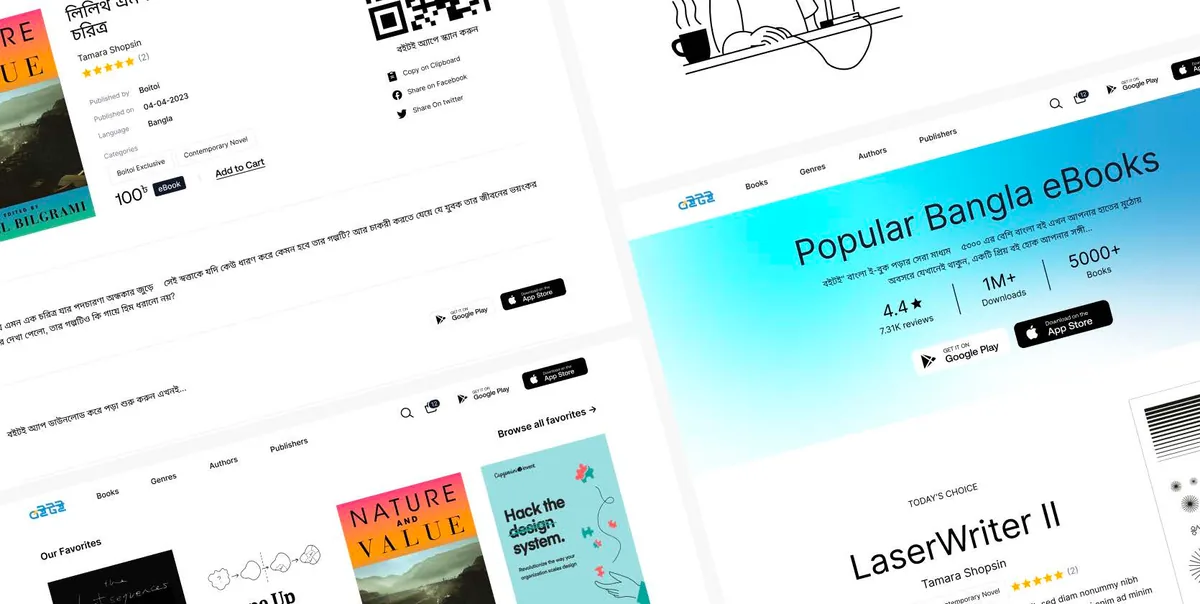
Reading the problem / Boitoi
The marketplace should earn the transition into reading.
A Bangla catalog and reader serve related but different moments: choosing a book and staying with its content.
Authorized Bangla books, a marketplace and a reader need a coherent journey rather than disconnected interfaces.
How can book discovery and reading feel like one experience for non-technical readers?
Evidence: the project account and the attributed artifacts on this page. Process drawings and interaction studies are reconstructed explanations; numerical research or business results are included only where separately supported.
02 / Boitoi
My role
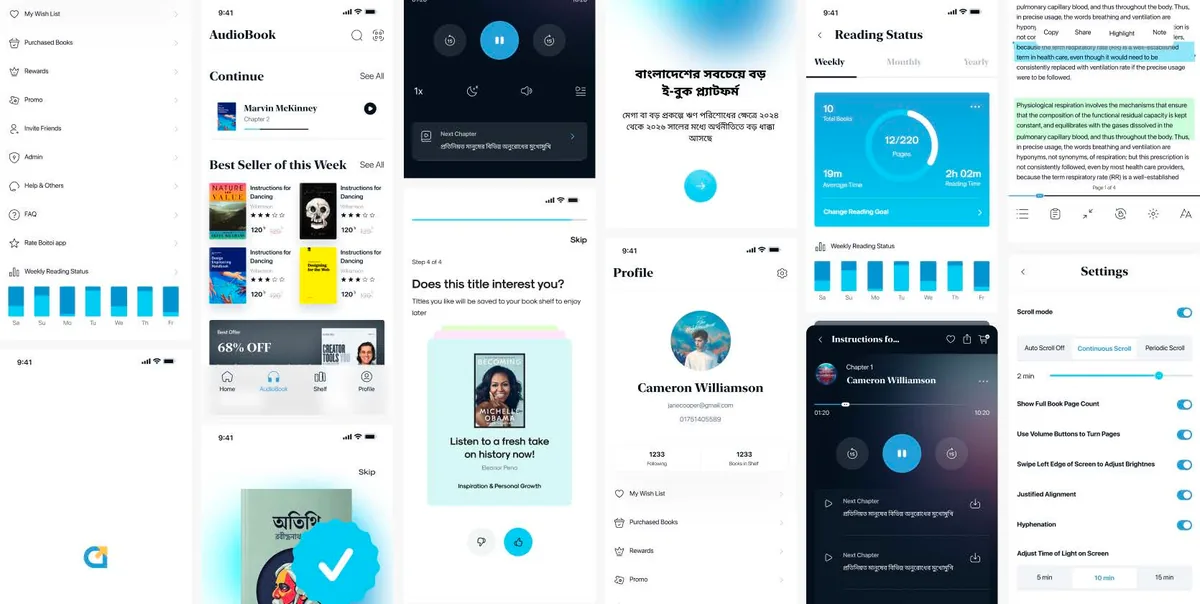
- Designed a minimalist dashboard for web and mobile.
- Integrated marketplace and reader into one seamless flow.
- Centered non-technical readers and writers in the process.
03 / Boitoi
The process
- Mapped the reader’s journey between finding a Bangla title and reading it.
- Explored the marketplace-to-reader transition in wireframes and prototypes.
- Developed the visual interface with engineering and monitored product engagement.
The process / Boitoi
A direction.
A way to build it.
The design process connects the decision to choose a Bangla book with the experience of spending time reading it.
A schematic of sequence and overlap, not a dated project schedule.
Frame reader needs
Consider non-technical readers and writers alongside the need for an authorized eBook marketplace.
Join discovery and reading
Map book discovery, detail, access and reader entry as one connected journey.
Explore the reading hierarchy
Use wireframes and prototypes to separate catalog comparison from sustained reading.
Refine with development
Carry long titles, metadata and reading content into interface implementation and subsequent product review.
How can book discovery and reading feel like one experience for non-technical readers?
Discovery is only the beginning of a book experience. A reader needs enough detail to choose a title, a clear route into the reader and a way to continue without reorienting every time. Connecting these stages addresses the split between acquiring a book and spending time with it.
Journey map / Boitoi
See the whole task in context.
Choose a step to connect the person’s intent with the interface and the design decision.
Current intent
Discover a title
Authorized Bangla books, a marketplace and a reader need a coherent journey rather than disconnected interfaces.
- Interface context
- Book discovery
- Review question
- What does a reader need to know before opening or acquiring a book?
Representative task sequence and recovery path, not a measured emotional curve or historical research map.
Behind the experience
The visible task depends on work behind it.
For Boitoi, this map connects “Discover a title” to “Continue reading”. Read across to follow the task, then select a layer to inspect the interface, design and delivery references behind it.
| Layer | Discover a title | Review book details | Open the reader | Continue reading |
|---|---|---|---|---|
| The task | Discover a title | Review book details | Open the reader | Continue reading |
| Visible interface | Book discovery | Book discovery | Book detail | Reading view |
| Design checkpoint | Authorized Bangla books, a marketplace and a reader need a coherent journey rather than disconnected interfaces. | Help a reader find a relevant authorized Bangla title. | Explain the book before asking for the next commitment. | Let the text become the main experience. |
| Implementation reference | Consider non-technical readers and writers alongside the need for an authorized eBook marketplace. | Map book discovery, detail, access and reader entry as one connected journey. | Use wireframes and prototypes to separate catalog comparison from sustained reading. | Carry long titles, metadata and reading content into interface implementation and subsequent product review. |
| Recovery | Book not yet available → explain access → retain the title and reading context | |||
A reconstructed delivery map: the implementation row summarizes design-process dependencies, rather than claiming to document the original backend architecture.
A clear catalog-to-reader transition.
Reconstructed comparison of design approaches. These are review studies, not a claim that both directions were historically tested or shipped.
What this direction changes
A clear catalog-to-reader transition
Lets book detail establish the choice before reading takes priority.
Give discovery and sustained reading different rhythms.
The documented process includes journeys, wireframes and prototypes. The reconstruction gives discovery room for comparison, book detail room for a decision and the reader room for the text itself. Controls can remain available without demanding the same attention at every stage.
01 / Book discovery
Boitoi⌕
01Book discovery↗
02Book detail↗
03Reading view↗
Review book details
Help a reader find a relevant authorized Bangla title.
02 / Book detail
Boitoi⌕
Discover a titleBook discovery
Review book detailsBook detail ⌄
✓Open the reader
Open the reader
Explain the book before asking for the next commitment.
03 / Reading view
Boitoi⌕
Continue reading
- Book discovery
- Review
- Book detail
- Review
Continue reading
Let the text become the main experience.
Try the interaction
Boitoi / Task & review study
Boitoi01 / 03
View 01
Book discovery
Help a reader find a relevant authorized Bangla title.
Keep this context visibleBook discovery
Help a reader find a relevant authorized Bangla title.
Starting context
Discover a title
Bengali reading comfort is a product decision.
Treat long Bengali book titles, author metadata and reading text as different roles. Reading comfort depends on line height and measure as much as headline style.
Illustrative type-role specimenBoitoi
Discover a title.
Continue reading.
HeadingBook detail
24 / 30 px · regularBodyHow can book discovery and reading feel like one experience for non-technical readers?
16 / 26 px · regularLabelContinue reading
12 / 18 px · regularStateBook not yet available → explain access → retain the title and reading context
12 / 18 px · regularPortfolio-font hierarchy illustration; the source does not establish the exact client font or token scale.
Protect the reading experience after the sale.
What does a reader need to know before opening or acquiring a book?
The book-detail view should explain what the reader is choosing without turning into a barrier for non-technical audiences. Information and action need to appear together.
Which controls should recede during reading while remaining easy to recover?
Once reading begins, the interface should support the text rather than compete with it. Long-form typography deserves different treatment from catalog headings and metadata.
Carry a title’s identity from catalog to reader.
Product design and developer collaboration need a shared understanding of discovery, book access and reading controls. Handoff examples should include long Bengali titles and reading content, rather than only short catalog placeholders.
Future AI-assisted changes should be reviewed separately in marketplace and reading contexts. A component that works for a book card should not automatically define the typography or interaction of a long-form reader.
Boitoi’s product milestones sit within a broader marketplace and publishing effort; the case study focuses on the interface contribution.
Accessibility & standards
Access belongs in the design.
For Boitoi, carry accessibility requirements from the core user journey into component states, prototypes and engineering acceptance criteria.
WCAG 2.2 AA · EN 301 549 · APCA · WAI-ARIA · Platform guidance
Read and navigate with assistive technology
Specify accessible names, logical reading order and meaningful control roles. Plan VoiceOver or TalkBack checks, Dynamic Type or text scaling, and platform-appropriate touch targets.
Preserve meaning across themes
Review WCAG 2.2 AA contrast and non-color cues in light and dark appearances; use APCA as an additional typography-readability check.
Respect native behavior
Use Apple HIG and relevant Android guidance for navigation, gestures, focus and motion preferences. Give gesture-driven actions a discoverable alternative.
Review scope & standards references
These are design references and review priorities, not a claim that this historical project passed a WCAG audit. Record criterion-level evidence, assistive-technology and device results, unresolved issues and retest outcomes before making a conformance statement.
APCA supplements the WCAG 2.2 contrast checks; it does not replace them. WCAG 3 remains a draft. EN 301 549 v4.1.1 is the latest published edition checked on 6 November 2026; its publication and its formal EU legal citation are separate matters. Confirm the applicable procurement or legal baseline with the client.
Outcomes & scope
What the work delivers.
- 10M monthly users within four years.
- Became Bangladesh’s #1 eBook reader.
- ~$20k/mo revenue from the growing base.
Results are described within the documented project scope. Illustrative studies are identified separately from original project artifacts.
Review & next iteration
What needs to hold up in use.
Use these questions to review Boitoi against the behavior the design is intended to support.
- 01
Can a reader locate the book and understand the next step?
- 02
Can they return to the catalog without losing the reading context?
Project-specific acceptance questions for a future review, not reported usability-test results.
Reflection / Boitoi
What I’d carry forward.
Discovery earns its value when it leads comfortably into reading. Catalog decisions and reading controls need to serve the same continuing relationship with a book.