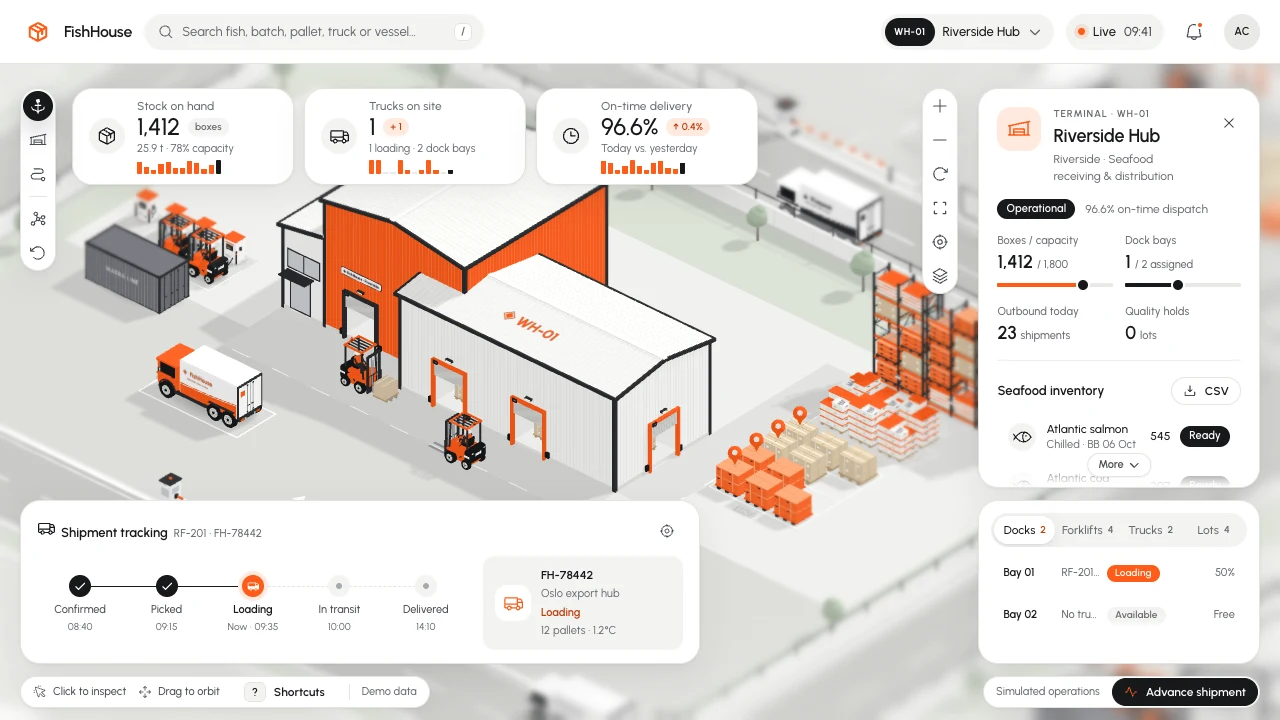
Original development capture
01 / FishHouse
The scene gets attention. The operating rule earns trust.
FishHouse began with a cold-chain question: how can someone understand both where the stock is and whether it can move? A campus view supplies the first answer. Lot detail, quality conditions and shipment milestones supply the second. Keeping them connected is the product-design problem.
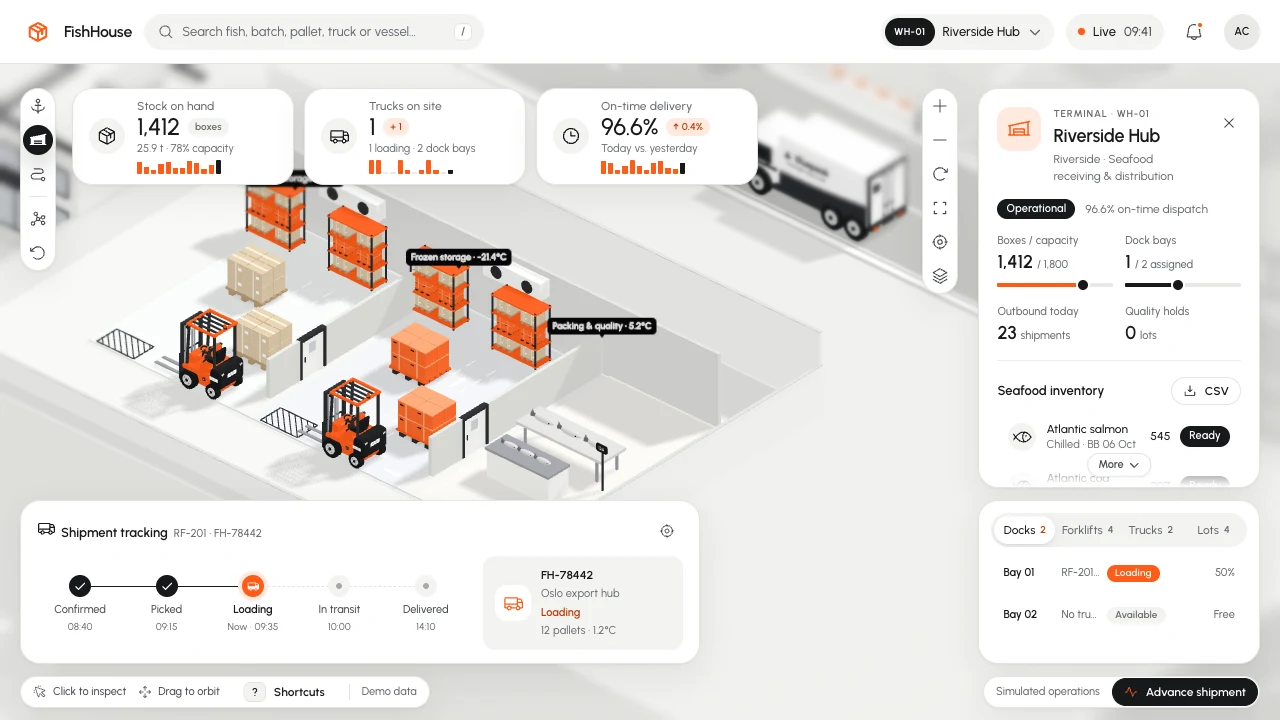
I organized the workspace around a selected terminal, then kept stock, dock and fleet information in persistent screen-space panels. Outdoor and indoor views change the physical context without asking the user to relearn the controls. The example shown here is Riverside Hub, one of five fictional terminals.
Reading the problem / FishHouse
An unavailable shipment needs an understandable reason.
The cold-chain PoC connects stock, quality holds, dispatch rules and movement across terminals.
This is a cold-chain operations proof of concept with simulated data and five terminals, not a live warehouse deployment.
How can a 3D operations workspace make stock and dispatch constraints visible?
Evidence: the project account and the attributed artifacts on this page. Process drawings and interaction studies are reconstructed explanations; numerical research or business results are included only where separately supported.
02 / FishHouse
One visual language, four different operating jobs.
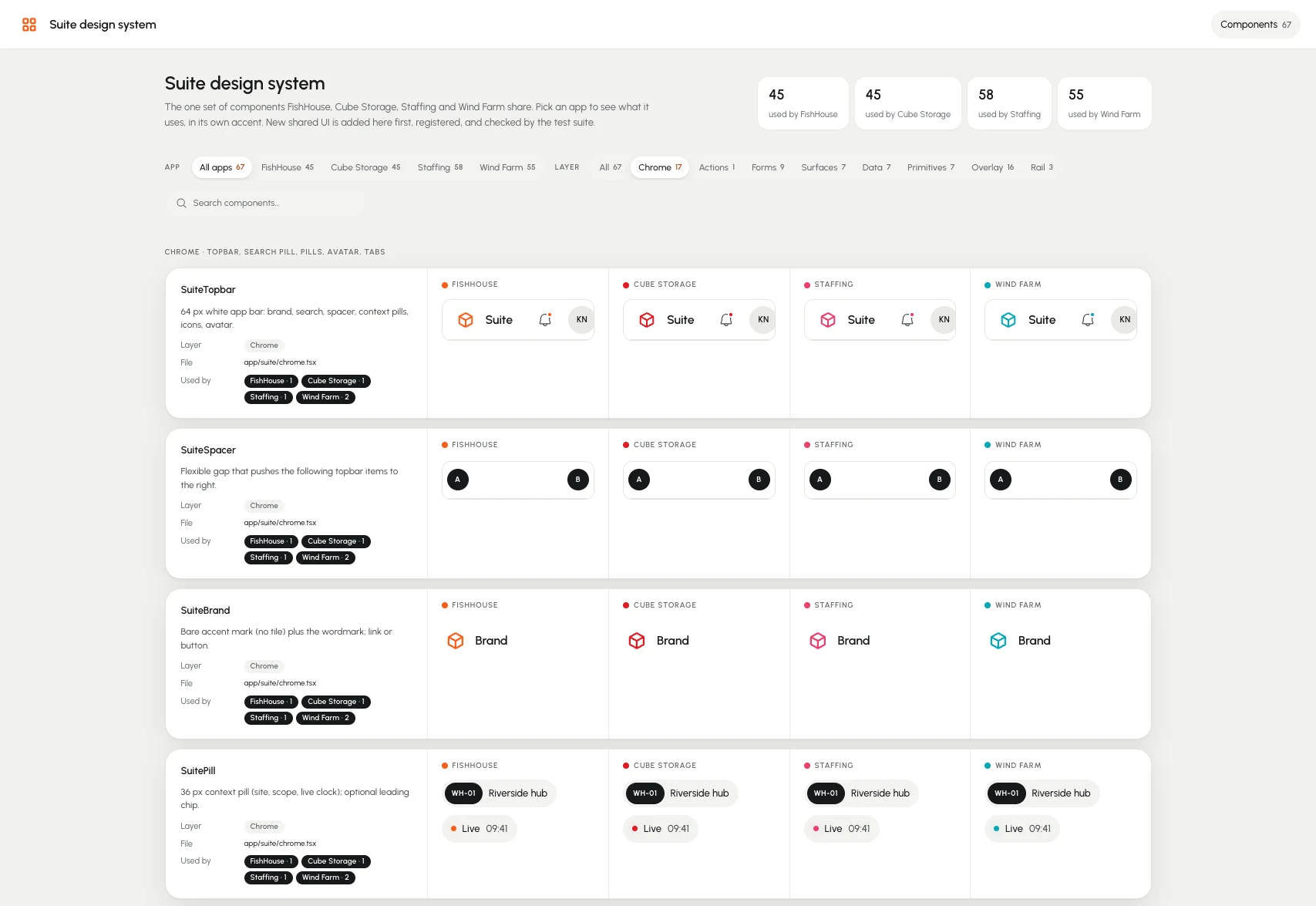
The reusable work sits beneath the screenshots: a Suite library used by FishHouse, Cube Storage, Staffing and Wind Farm. The live catalog currently lists 67 registered components and lets a reviewer filter by application, layer or name. Component usage is derived from source, so the catalog shows where a pattern actually appears.
Shared tokens own color, typography, sizing, radii, elevation and stacking. Urbanist is the common typeface. FishHouse orange, Cube Storage red, Staffing pink and Wind Farm cyan provide identity through application accents; navigation, focus, field behavior and status semantics remain shared.
The library separates chrome, actions, forms, surfaces, data, primitives, overlays and scene rails. Topbars and search establish context. Badges and meters explain state. Tabs, filters and chart surfaces support detail. This makes consistency a reusable implementation decision, rather than a visual checklist repeated in four files.
03 / FishHouse
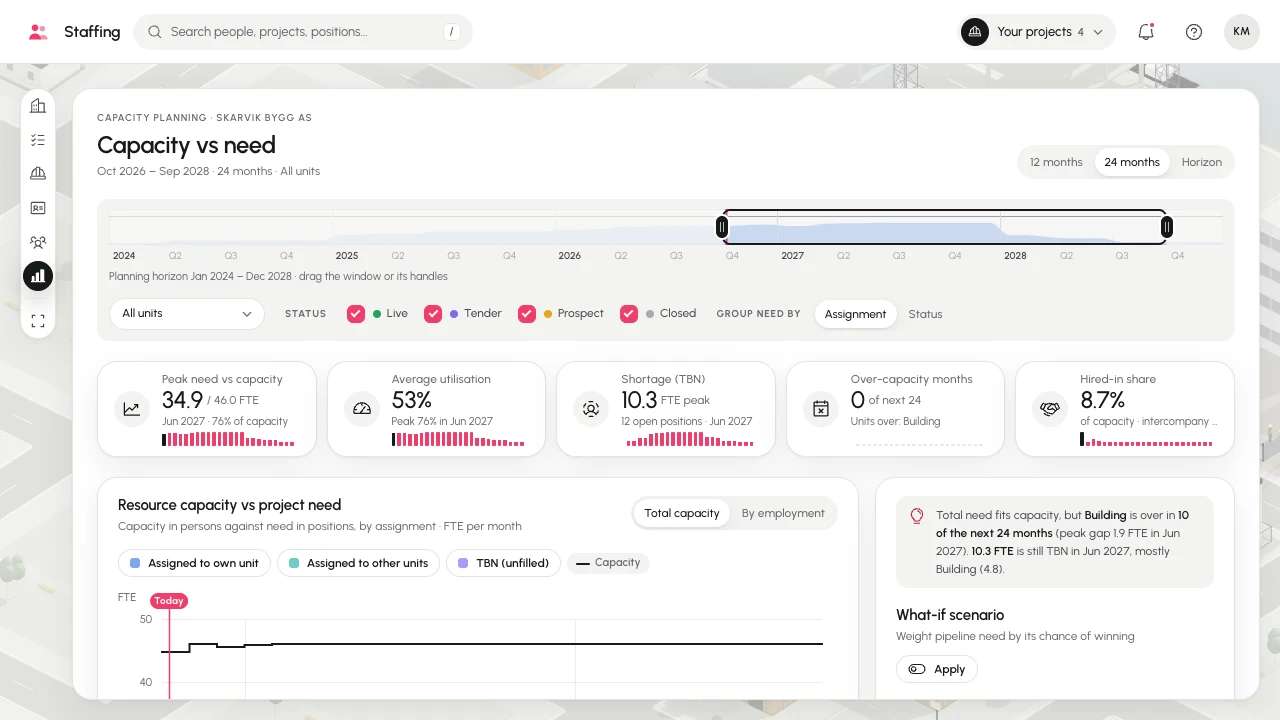
The dashboard is another view of the same design system.
Staffing demonstrates the system outside warehouse logistics. Its capacity dashboard compares demand and available people across a selected planning horizon. Filters, horizon controls, KPI cards and charts preserve the same control hierarchy used around the 3D scenes.
This is why I separated reusable interface behavior from domain logic. A workforce planner needs capacity and assignment language; a warehouse operator needs lots and dock status. They can share an interaction grammar without sharing a data model. The visible counts and forecasts are demo records, not business results.
04 / FishHouse
From a spatial twin to a phone-sized inspection.
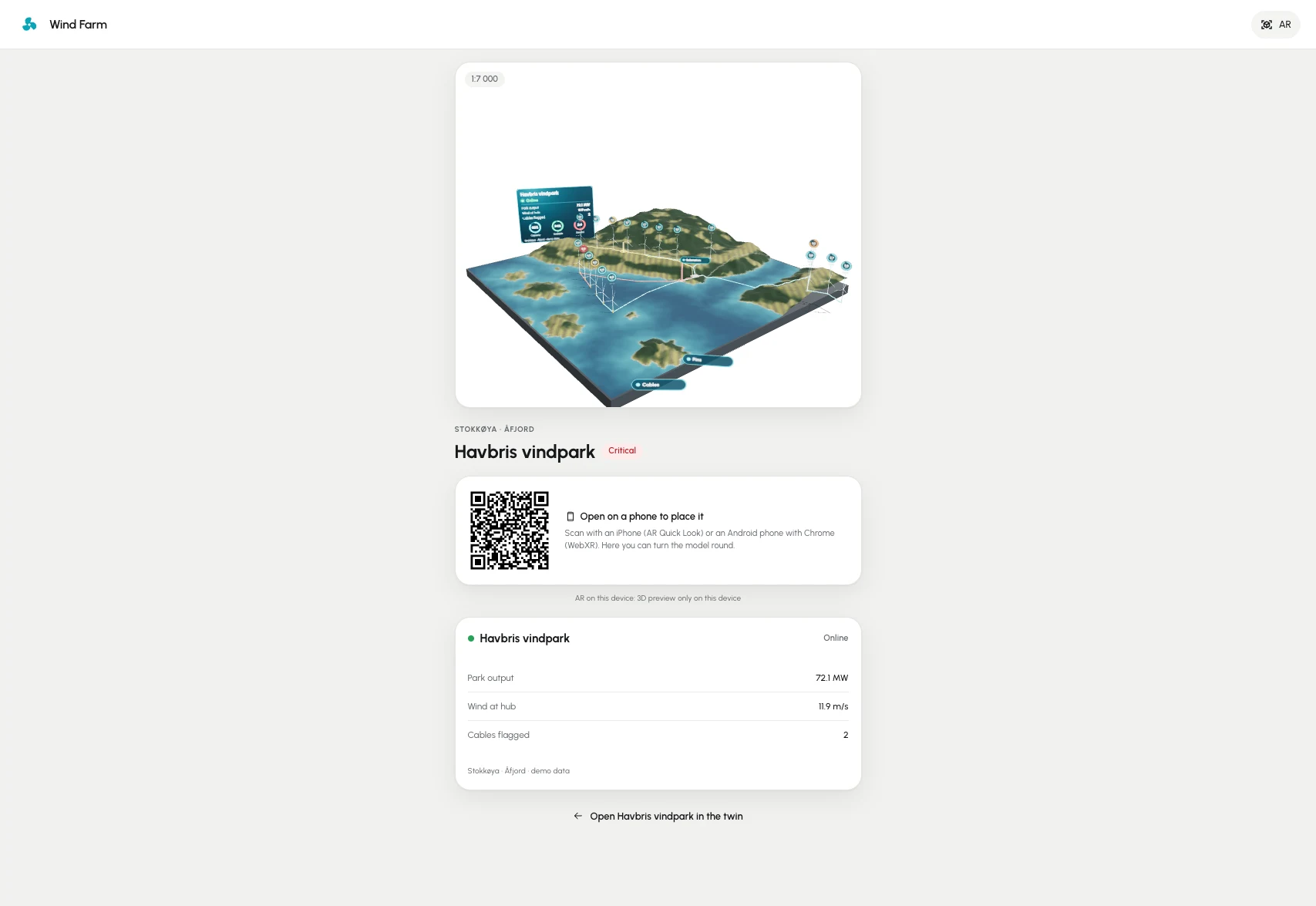
Wind Farm takes the shared foundations into asset inspection. The browser twin contains turbines, cables and substation context; its AR companion presents the selected asset with diagnostics and a phone handoff. The desktop view remains a rotatable 3D preview.
The companion explains the route into iPhone AR Quick Look or Android Chrome WebXR. The screenshot records the browser preview and handoff, not a claim that real-world tracking was tested here. Keeping that distinction explicit helps a reviewer understand what is built and which device checks remain.
05 / FishHouse
Automation needs a visible boundary.
A lot can be present but unavailable for dispatch. In FishHouse, local quality holds and simulated chilled-temperature excursions affect eligibility. Frozen cargo is not indiscriminately blocked by a chilled-zone issue. Shipment transitions also update represented vehicle movement and allocated quantities.
The optional browser tools have a smaller remit: read the selected warehouse state and inspect an object from a known ID list. They are feature-detected and schema constrained. This is an agent integration surface, while the operating simulation continues to work through ordinary UI. It is not an autonomous ERP workflow.
06 / FishHouse
A handoff the next implementation can follow.
The shared-system handoff names the source owner for each token and component, its composition, live demo and app usage. A source test checks registered exports, catalog coverage, duplicate ownership and token drift. An accepted baseline tracks remaining exceptions so new work cannot silently increase them.
For Claude or Codex changes, the working sequence is concrete: find the existing Suite pattern, inspect its token and variants, update the shared component when behavior is reusable, then review every consuming app. Keep warehouse dispatch state, staffing approvals and wind diagnostics in their own domain modules. Shared appearance does not justify shared business rules.
The process / FishHouse
A direction.
A way to build it.
The cold-chain simulation makes quality restrictions part of the journey from stock inspection to dispatch planning.
A schematic of sequence and overlap, not a dated project schedule.
Map the operating dependencies
Identify how inventory, quality holds, dispatch and fleet information affect one another.
Pair location with information
Separate the 3D terminal context from the persistent lot and state details.
Explore the dispatch workspace
Prototype how a stock inspection leads into a plan and its represented fleet movement.
Review restricted actions
Show why a quality hold blocks a step and what information remains available.
How can a 3D operations workspace make stock and dispatch constraints visible?
Inventory, quality holds, dispatch and fleet movement are connected operational states. The prototype’s value is in making those dependencies visible: stock can exist without being dispatchable, and a fleet view should not imply that every lot is ready to leave.
Journey map / FishHouse
See the whole task in context.
Choose a step to connect the person’s intent with the interface and the design decision.
Current intent
Inspect inventory
This is a cold-chain operations proof of concept with simulated data and five terminals, not a live warehouse deployment.
- Interface context
- Inventory terminal
- Review question
- Which information needs a persistent panel rather than a 3D label?
Representative task sequence and recovery path, not a measured emotional curve or historical research map.
Behind the experience
The visible task depends on work behind it.
For FishHouse, this map connects “Inspect inventory” to “Track fleet movement”. Read across to follow the task, then select a layer to inspect the interface, design and delivery references behind it.
| Layer | Inspect inventory | Review quality holds | Prepare dispatch | Track fleet movement |
|---|---|---|---|---|
| The task | Inspect inventory | Review quality holds | Prepare dispatch | Track fleet movement |
| Visible interface | Inventory terminal | Inventory terminal | Quality & dispatch | Fleet overview |
| Design checkpoint | This is a cold-chain operations proof of concept with simulated data and five terminals, not a live warehouse deployment. | Locate the stock and its relevant terminal context. | Expose the quality condition that affects dispatch planning. | Connect fleet movement to the plan being inspected. |
| Implementation reference | Identify how inventory, quality holds, dispatch and fleet information affect one another. | Separate the 3D terminal context from the persistent lot and state details. | Prototype how a stock inspection leads into a plan and its represented fleet movement. | Show why a quality hold blocks a step and what information remains available. |
| Recovery | Quality hold prevents dispatch → explain the restriction → revise the plan | |||
A reconstructed delivery map: the implementation row summarizes design-process dependencies, rather than claiming to document the original backend architecture.
Review eligibility with the shipment.
Reconstructed comparison of design approaches. These are review studies, not a claim that both directions were historically tested or shipped.
What this direction changes
Review eligibility with the shipment
Keeps operational constraints close to the planned action.
Keep the dispatch restriction close to the stock.
The reconstructed inventory, quality-and-dispatch and fleet views explain the movement from inspection to planning. Each area retains the lot or terminal context needed to interpret the next action. The spatial scene supplies location; the panels make the operating constraint readable.
01 / Inventory terminal
0102Inventory terminal
Selected contextReview quality holdsOverview ↔ Detail
Review quality holds
Locate the stock and its relevant terminal context.
02 / Quality & dispatch
0102Quality & dispatch
Selected contextPrepare dispatchOverview ↔ Detail
Prepare dispatch
Expose the quality condition that affects dispatch planning.
03 / Fleet overview
0102Fleet overview
Selected contextTrack fleet movementOverview ↔ Detail
Track fleet movement
Connect fleet movement to the plan being inspected.
Try the interaction
FishHouse / Selection & context study
FishHouse01 / 03
View 01
Inventory terminal
Locate the stock and its relevant terminal context.
Selected contextInventory terminal
Locate the stock and its relevant terminal context.
Starting context
Inspect inventory
Lots, units and quality states need a stable home.
The source declares Urbanist as the suite’s sole typeface, self-hosted through next/font. Shared tokens define typography alongside colors, control sizing, radii and elevation. Headings identify the selected terminal or asset; numeric readings keep their units; badges distinguish quality and shipment state without relying only on an app accent.
Documented families / UrbanistFishHouse
Inspect inventory.
Track fleet movement.
HeadingQuality & dispatch
24 / 30 px · regularBodyHow can a 3D operations workspace make stock and dispatch constraints visible?
16 / 26 px · regularLabelTrack fleet movement
12 / 18 px · regularStateQuality hold prevents dispatch → explain the restriction → revise the plan
12 / 18 px · regularUrbanist is verified in the source and visible in the original captures above. This explanatory specimen uses the portfolio font, not the original Suite type rendering.
FishHouse
#ff5c1aCube Storage
#e11b22Staffing
#ef3d6aWind Farm
#0aa5b8Source tokens / 64 px topbar · 36 px controls · 28 px context chip · 12 px item gap. App accents identify the workspace; shared critical, warning and success tokens describe operational status.
Explore the live Suite component catalog ↗Verified in the project’s source library
Foundations become reusable interface behavior.
- TokensColor, status, Urbanist typography, radii, shadows, control sizes and z-index
- Chrome & railTopbar, search, site context, tabs and scene toolbar controls
- Forms & actionsInput, selection and action patterns shared across applications
- Surfaces & dataCards, charts, tables and operational information hierarchy
- Primitives & overlaysBadges, meters, tooltips, menus and composed feedback
Source library inventory / Refer to the linked catalog or design file for original variants and usage.
- SuiteTopbar
- SuiteBrand
- SuitePill
- SuiteChip
- SuiteIconButton
- App-filtered catalog
- Source-scanned usage
- Registered component demos
- Token drift checks
Use spatial context without hiding the restriction.
Which information needs a persistent panel rather than a 3D label?
A persistent panel can carry lot identifiers, quantities and quality information while the scene shows location. Moving every reading into 3D would make comparison and sustained reading harder.
How should a quality hold block an action while explaining the recovery path?
A quality hold should explain why dispatch is unavailable and what planning options remain. Merely disabling an action would hide the rule that the simulation is intended to demonstrate.
Link a dispatch action to its preconditions.
FishHouse is a simulated cold-chain workspace across five terminals. An implementation reference should identify the inventory and quality state that permit or block an operation, then show how that decision becomes visible in dispatch and fleet views.
Claude and Codex implementation should start in app/suite: reuse an existing component, route shared visual changes through tokens, register new patterns in the catalog, and run the suite design-system checks. Keep domain transitions separate. Review both eligible and held stock before changing dispatch behavior; preserve the distinction between planned and underway movement.
FishHouse demonstrates operations logic with simulated data; it is not presented as a live cold-chain installation.
Accessibility & standards
Access belongs in the design.
For these operational workflows, prioritize readable status data, non-color alerts, accessible approval controls and a 2D alternative to spatial inspection.
WCAG 2.2 AA · EN 301 549 · APCA · WAI-ARIA · Platform guidance
Make spatial information available in another form
Provide a meaningful 2D or text route to tasks and data presented in 3D. Review keyboard, pointer and assistive-technology access to the surrounding interface.
Reduce visual and physical demands
Plan readable labels, non-color status cues, stable interaction targets and alternatives to precision gestures. Respect reduced motion and avoid relying on camera movement to communicate state.
Separate usability from safety assurance
Use ISO 9241-210 human-centred design principles and relevant platform guidance alongside WCAG 2.2 AA and EN 301 549 review. Industrial usability work is not evidence of safety certification.
Review scope & standards references
These are design references and review priorities, not a claim that this historical project passed a WCAG audit. Record criterion-level evidence, assistive-technology and device results, unresolved issues and retest outcomes before making a conformance statement.
APCA supplements the WCAG 2.2 contrast checks; it does not replace them. WCAG 3 remains a draft. EN 301 549 v4.1.1 is the latest published edition checked on 6 November 2026; its publication and its formal EU legal citation are separate matters. Confirm the applicable procurement or legal baseline with the client.
Outcomes & scope
What the work delivers.
- Independent, working browser prototypes using fictional records and simulated operations. The four apps share UI foundations, not operational data. No live ERP, physical robots, production sensors or durable warehouse ledger is claimed. FishHouse’s visual exploration credits Dilum Sanjaya’s warehouse reference and Fished workflow research.
Results are described within the documented project scope. Illustrative studies are identified separately from original project artifacts.
Review & next iteration
What needs to hold up in use.
Use these questions to review FishHouse against the behavior the design is intended to support.
- 01
Can an operator identify why a stock item is on hold?
- 02
Does dispatch preserve the selected terminal and shipment context?
Project-specific acceptance questions for a future review, not reported usability-test results.
Reflection / FishHouse
What I’d carry forward.
Dispatch decisions depend on constraints as much as available capacity. A useful planning interface exposes why an assignment cannot proceed and what can be changed next.