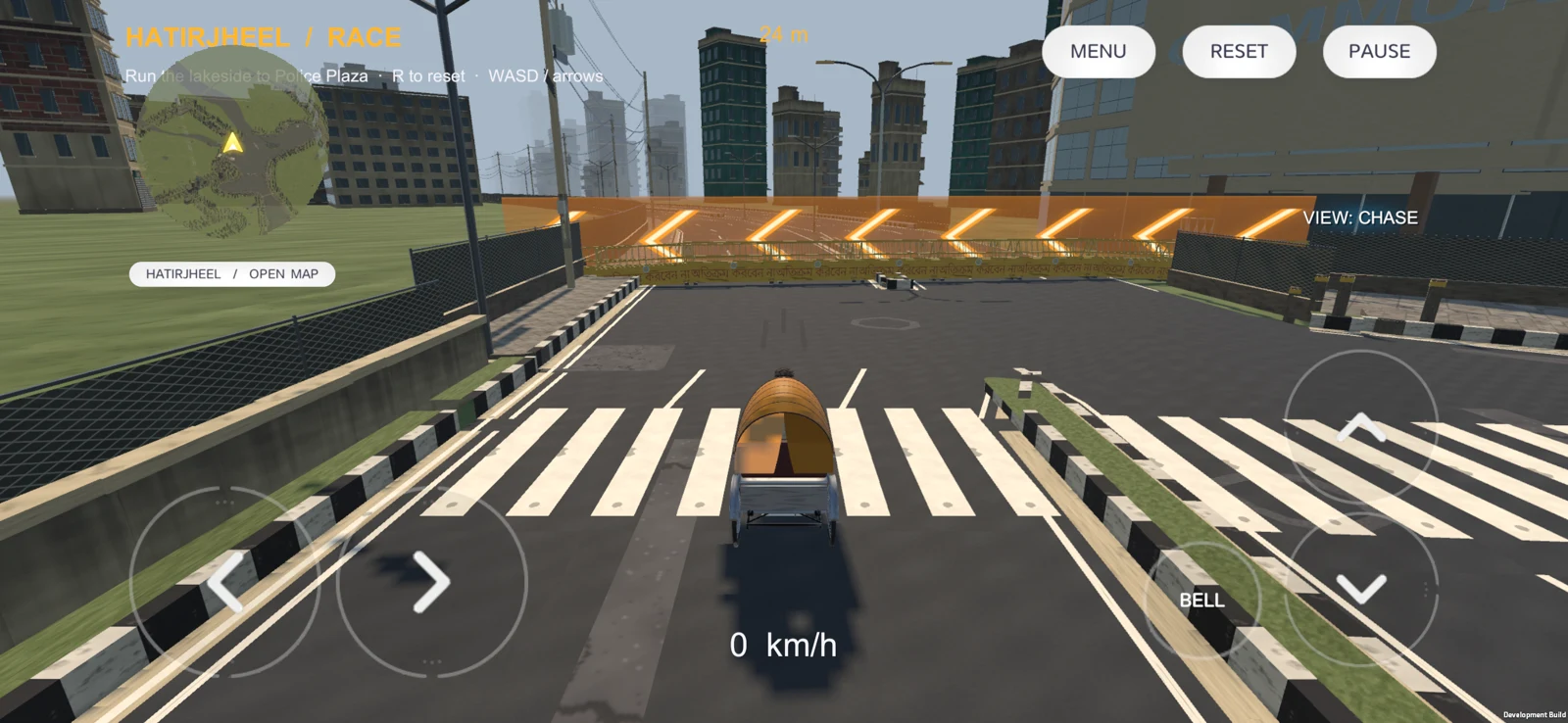
Original development capture
01 / Agentic Unity Development Workflow
The challenge
Coordinate agents working across gameplay, assets and validation while preserving shared project state and making checks repeatable.
Reading the problem / Agentic Unity Development Workflow
An editor change still needs acceptance.
The workflow links scoped tasks, editor jobs, Play Mode checks and captured results. A successful command is only one part of review.
Gameplay, assets and validation share project state. The workflow is a proof of concept rather than a claim of autonomous production delivery.
How can an agent-assisted Unity workflow produce an inspectable change rather than an opaque result?
Evidence: the project account and the attributed artifacts on this page. Process drawings and interaction studies are reconstructed explanations; numerical research or business results are included only where separately supported.
02 / Agentic Unity Development Workflow
The approach
The workflow links scoped task handoffs to code and asset generators, Unity editor jobs, deterministic checks, Play Mode captures and device smoke scripts. Shared work is preserved through explicit ownership and review. Reports and captures help identify failures before the next iteration.
- Scope the tasks. Assign bounded implementation and validation work to subagents.
- Generate and build. Run repeatable Blender and Unity editor workflows.
- Validate scenarios. Run scripted checks, Play Mode validation and captures.
- Review and iterate. Inspect reports and screenshots, then address failures.
03 / Agentic Unity Development Workflow
My contribution
- Use multiple subagents for scoped implementation, asset generation and validation tasks in Rickshaw Rush.
- Connect repeatable Blender generators and exports to Unity editor builders and validation jobs.
- Run autonomous scripted checks for defined gameplay and scene scenarios, including Play Mode validation and screenshot captures.
- Use Android and iOS device smoke workflows, validation reports and human visual review to guide iteration.
The process / Agentic Unity Development Workflow
A direction.
A way to build it.
The workflow makes a scoped editor task, its execution and the validation evidence independently inspectable.
A schematic of sequence and overlap, not a dated project schedule.
Bound the editor request
Define the change, shared project state and evidence expected from the task.
Coordinate the work
Connect gameplay and asset steps with the editor operation they support.
Run and validate the change
Use the proof-of-concept workflow to link generated work with editor jobs and Play Mode checks.
Review the resulting capture
Compare the visible result and checks with the original request before calling the task complete.
How can an agent-assisted Unity workflow produce an inspectable change rather than an opaque result?
The workflow links a scoped request to editor execution, Play Mode validation and a visual result. Each stage answers a different question: what was requested, what ran, what was checked and what a reviewer can inspect. Completion needs that chain of evidence.
Journey map / Agentic Unity Development Workflow
See the whole task in context.
Choose a step to connect the person’s intent with the interface and the design decision.
Current intent
Scope an editor task
Gameplay, assets and validation share project state. The workflow is a proof of concept rather than a claim of autonomous production delivery.
- Interface context
- Scoped task
- Review question
- What evidence is needed before marking a generated change complete?
Representative task sequence and recovery path, not a measured emotional curve or historical research map.
Behind the experience
The visible task depends on work behind it.
For Agentic Unity Development Workflow, this map connects “Scope an editor task” to “Review the capture”. Read across to follow the task, then select a layer to inspect the interface, design and delivery references behind it.
| Layer | Scope an editor task | Run the build step | Validate in Play Mode | Review the capture |
|---|---|---|---|---|
| The task | Scope an editor task | Run the build step | Validate in Play Mode | Review the capture |
| Visible interface | Scoped task | Scoped task | Editor execution | Validation review |
| Design checkpoint | Gameplay, assets and validation share project state. The workflow is a proof of concept rather than a claim of autonomous production delivery. | Bound the requested change and its shared project context. | Show the editor job independently from its validation. | Connect the capture and checks back to the requested behavior. |
| Implementation reference | Define the change, shared project state and evidence expected from the task. | Connect gameplay and asset steps with the editor operation they support. | Use the proof-of-concept workflow to link generated work with editor jobs and Play Mode checks. | Compare the visible result and checks with the original request before calling the task complete. |
| Recovery | Validation fails → inspect the result → revise the scoped task | |||
A reconstructed delivery map: the implementation row summarizes design-process dependencies, rather than claiming to document the original backend architecture.
Validate and inspect the result.
Reconstructed comparison of design approaches. These are review studies, not a claim that both directions were historically tested or shipped.
What this direction changes
Validate and inspect the result
Provides a stopping point between implementation and acceptance.
Separate the job from its validation evidence.
The task, execution and review surfaces are reconstructed as distinct work areas. A generated asset or gameplay change should not inherit a passing status merely because an editor job finished. The review view needs to expose the evidence relevant to the original task.
01 / Scoped task
Agentic Unity Development Workflow⌕
01Scoped task↗
02Editor execution↗
03Validation review↗
Run the build step
Bound the requested change and its shared project context.
02 / Editor execution
Agentic Unity Development Workflow⌕
Scope an editor taskScoped task
Run the build stepEditor execution ⌄
✓Validate in Play Mode
Validate in Play Mode
Show the editor job independently from its validation.
03 / Validation review
Agentic Unity Development Workflow⌕
Review the capture
- Scoped task
- Review
- Editor execution
- Review
Review the capture
Connect the capture and checks back to the requested behavior.
Try the interaction
Agentic Unity Development Workflow / Task & review study
Agentic Unity Development Workflow01 / 03
View 01
Scoped task
Bound the requested change and its shared project context.
Keep this context visibleScoped task
Bound the requested change and its shared project context.
Starting context
Scope an editor task
Task instructions, logs and verdicts need different emphasis.
Separate task instructions, editor status, validation output and review notes. A passing check must be distinguishable from an unreviewed change.
Illustrative type-role specimenAgentic Unity Development Workflow
Scope an editor task.
Review the capture.
HeadingEditor execution
24 / 30 px · regularBodyHow can an agent-assisted Unity workflow produce an inspectable change rather than an opaque result?
16 / 26 px · regularLabelReview the capture
12 / 18 px · regularStateValidation fails → inspect the result → revise the scoped task
12 / 18 px · regularPortfolio-font hierarchy illustration; the source does not establish the exact client font or token scale.
Define what counts as finished before running the job.
What evidence is needed before marking a generated change complete?
A generated change needs evidence proportionate to its scope. Play Mode checks and a visual capture answer different questions, so one should not be used as an automatic substitute for the other.
Which parts of project state must be shared across asset, gameplay and validation work?
Gameplay and asset work share project state. A scoped task needs enough common context to avoid an apparently successful step that leaves another part of the project inconsistent.
Pass a bounded task and return reviewable evidence.
The proof of concept coordinates agent work, Blender-to-Unity generation, editor jobs and validation. The handoff should make the affected project state and expected evidence explicit, allowing a reviewer to judge the change without reconstructing the entire execution history.
Codex or another coding agent should receive a concrete editor task and defined validation conditions. Failed checks return the work to inspection; they should not be hidden behind a summary that treats execution as success.
This is an agent-assisted Unity workflow proof of concept, not a claim of unsupervised production delivery.
Accessibility & standards
Access belongs in the design.
For Agentic Unity Development Workflow, carry accessibility requirements from the core user journey into component states, prototypes and engineering acceptance criteria.
WCAG 2.2 AA · EN 301 549 · APCA · WAI-ARIA · Platform guidance
Complete the task without a mouse
Define tab order, visible and unobscured focus, named controls, table relationships and error recovery using native semantics and WAI-ARIA patterns.
Understand every state
Pair color with text or icons for selection, warnings and availability. Review text at WCAG contrast thresholds and use APCA alongside font size and weight for readability decisions.
Keep the workflow usable
Review zoom and reflow, 24 × 24 CSS-pixel minimum targets or qualifying spacing, alternatives to dragging, validation and accessible authentication where applicable.
Review scope & standards references
These are design references and review priorities, not a claim that this historical project passed a WCAG audit. Record criterion-level evidence, assistive-technology and device results, unresolved issues and retest outcomes before making a conformance statement.
APCA supplements the WCAG 2.2 contrast checks; it does not replace them. WCAG 3 remains a draft. EN 301 549 v4.1.1 is the latest published edition checked on 6 November 2026; its publication and its formal EU legal citation are separate matters. Confirm the applicable procurement or legal baseline with the client.
Outcomes & scope
What the work delivers.
- Development workflow proof of concept in Rickshaw Rush, a Ridmik Labs game. Autonomous testing means scripted validation of defined scenarios; it does not imply complete gameplay coverage or an unattended release pipeline. Human review remains part of asset integration and delivery. The image is a development capture.
Results are described within the documented project scope. Illustrative studies are identified separately from original project artifacts.
Review & next iteration
What needs to hold up in use.
Use these questions to review Agentic Unity Development Workflow against the behavior the design is intended to support.
- 01
Can a reviewer trace the capture to the task and editor job?
- 02
Does a failed validation prevent acceptance of the change?
Project-specific acceptance questions for a future review, not reported usability-test results.
Reflection / Agentic Unity Development Workflow
What I’d carry forward.
Creating an editor change and accepting it are separate responsibilities. A useful agent workflow keeps the proposed change inspectable before it enters the game project.