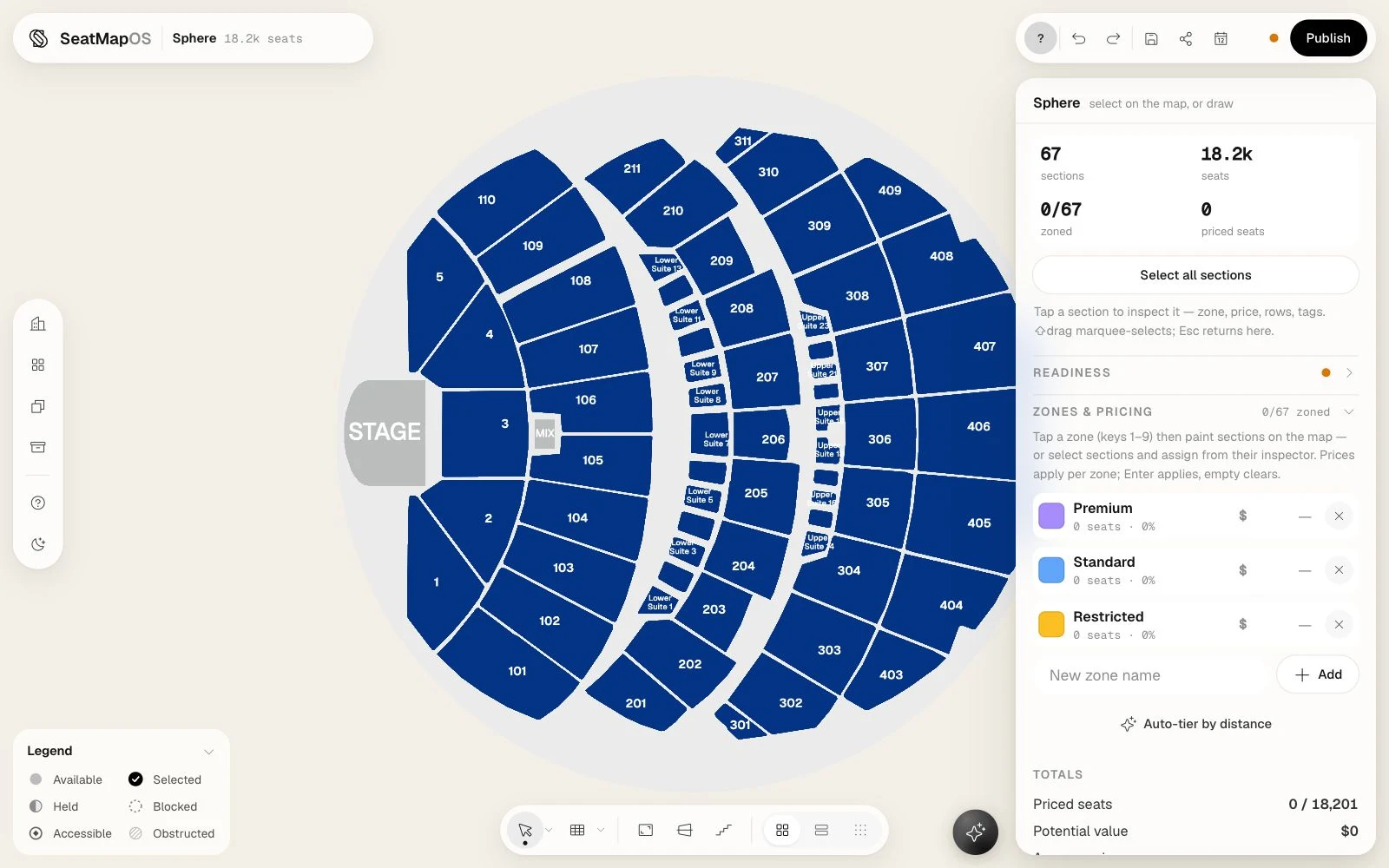
Original product capture / The venue editor, selection context, readiness and pricing-zone controls.
01 / SeatMapOS
The venue is a working model, not a finished picture.
A venue operator needs more than an attractive diagram. They need to create a layout, arrange sections, reconcile seat counts, assign prices and decide whether the result is ready to publish. A buyer has a different task: understand where an option is, compare the view and know what selecting or holding it actually means.
SeatMapOS connects those responsibilities through the same underlying venue model. My product design and functional prototyping focused on the transitions between them: an editable chart becomes inventory, a buyer’s visual choice becomes a temporary hold, and a confirmed operation must retain the meaning established in the interface.
Reading the problem / SeatMapOS
Every transition changes the meaning of the map.
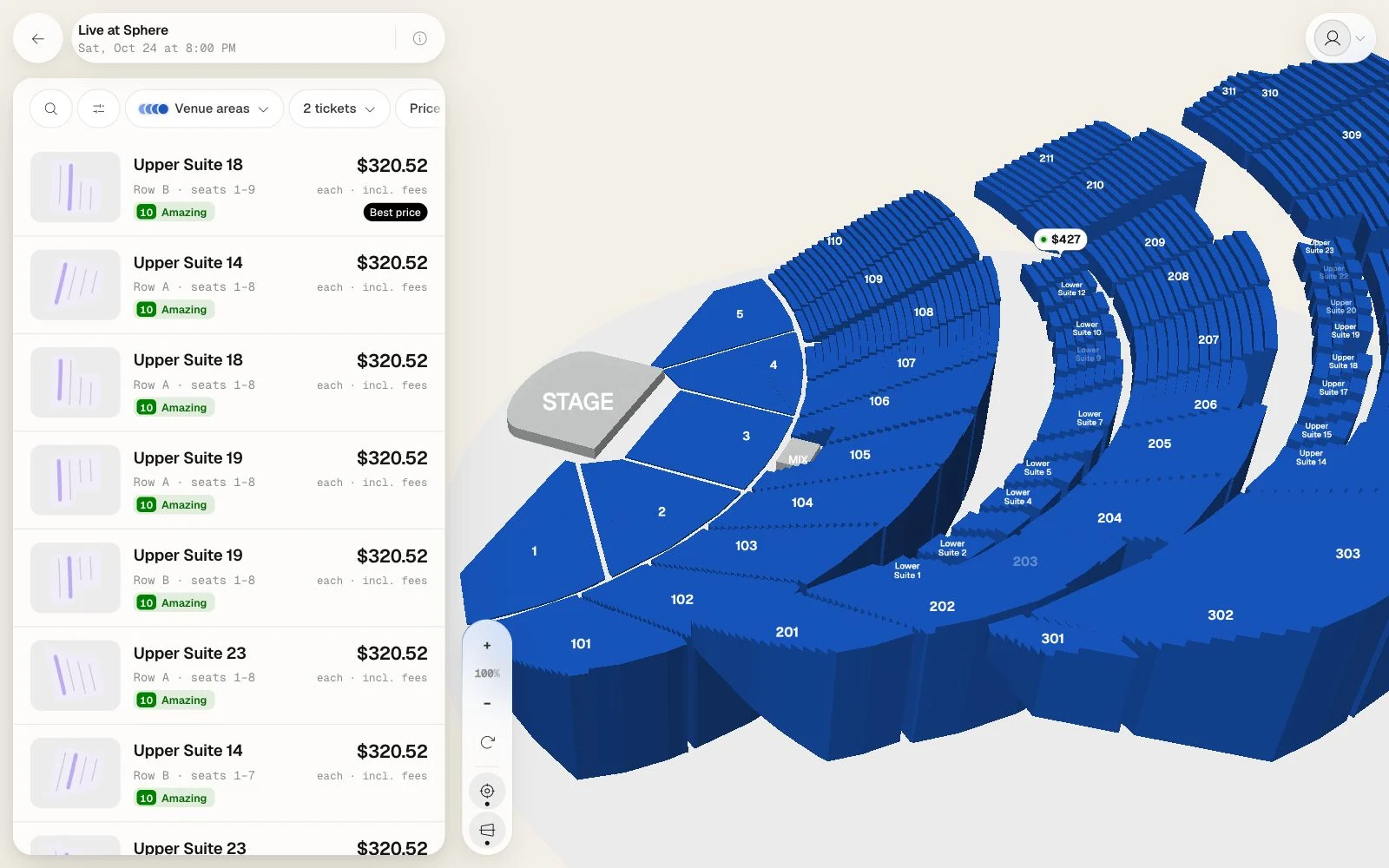
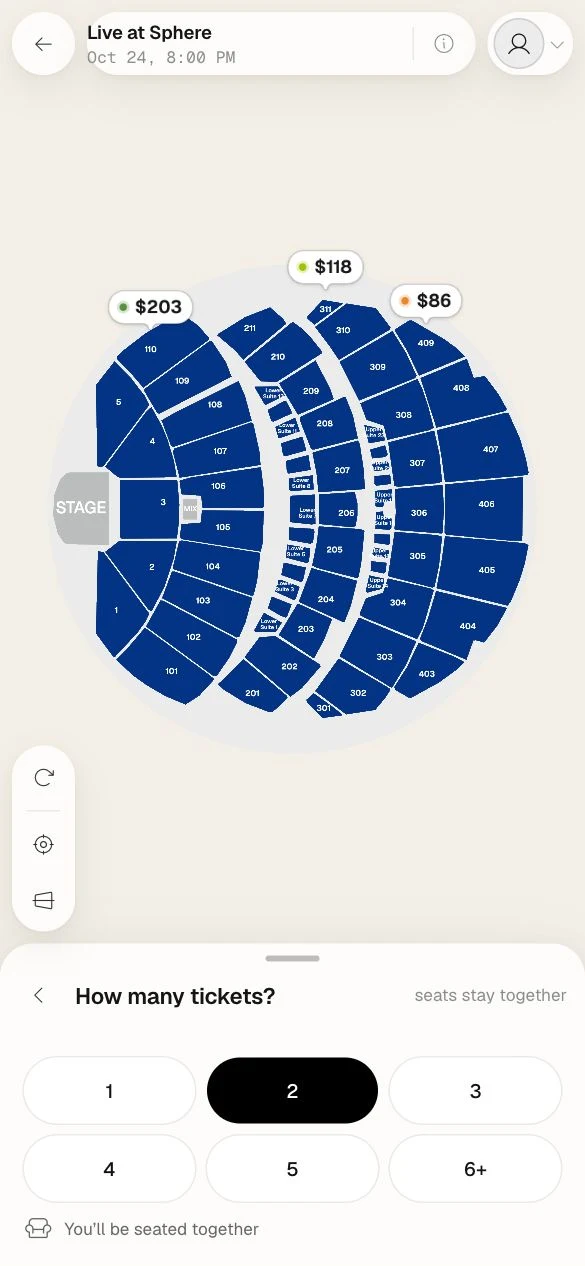
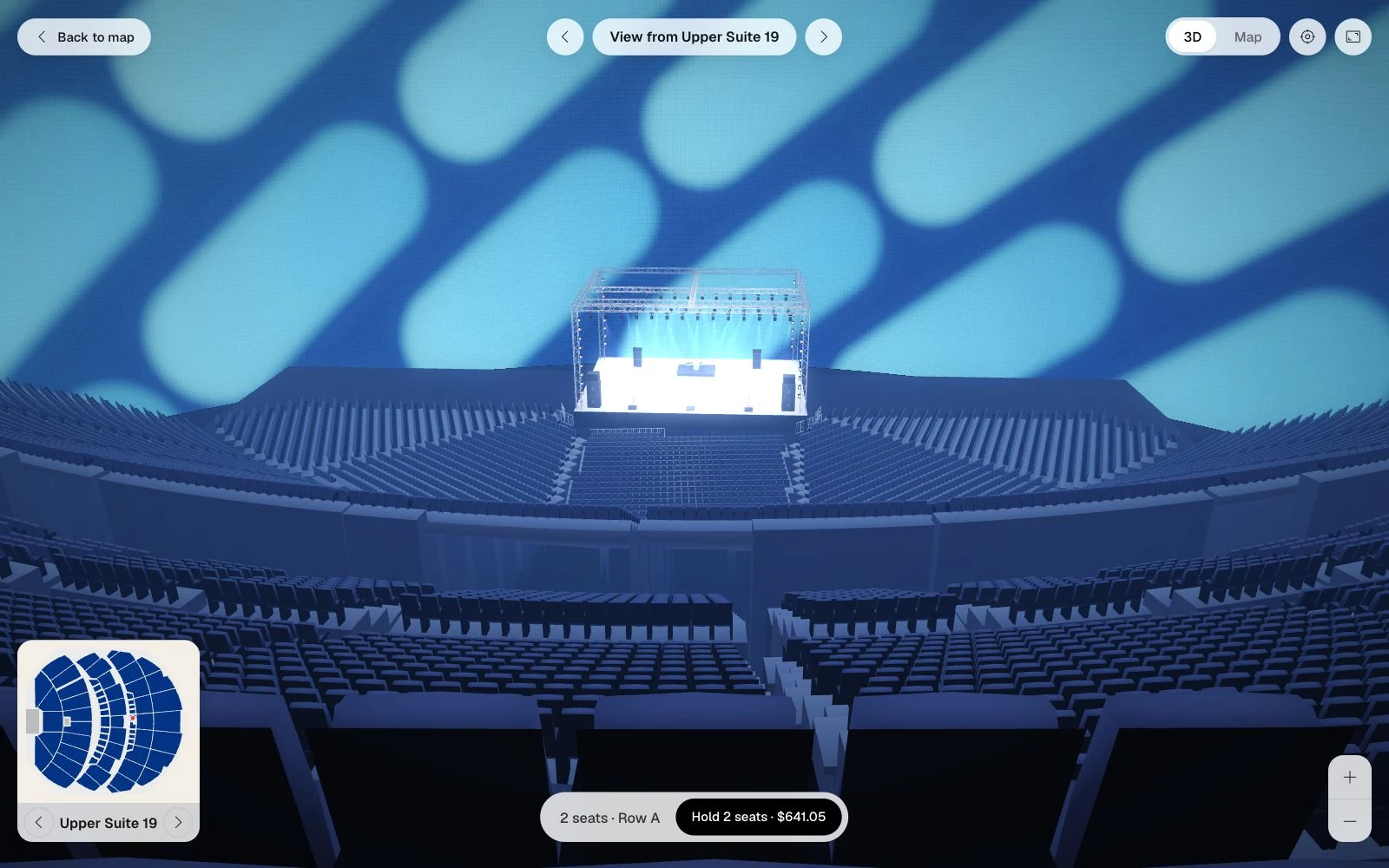
Original captures show a contextual venue editor, responsive ticket selection and 3D inspection. The source separately defines editable geometry, publication phases, SDK events and the hold-confirm state engine. A complete design account needs to connect those references.
Authoring, rendering and booking share venue data but have different commitments. A draft, a preview, a selection and a confirmed booking must remain distinguishable.
How can editable venue geometry become understandable inventory without losing context between the operator and the buyer?
Evidence: the project account and the attributed artifacts on this page. Process drawings and interaction studies are reconstructed explanations; numerical research or business results are included only where separately supported.
02 / SeatMapOS
Start with a measurable brief.
The venue-creation flow makes identity, location, dimensions and starting material explicit. A creator can begin from a procedural stadium, arena or theater, a section manifest, or a tracing reference. New measured projects carry a defined physical scale, while existing examples preserve their earlier scale instead of silently changing underneath their author.
These inputs have different authority. A spreadsheet can establish section names, rows, seat counts, capacity and ticket types; it does not establish the building’s real geometry. Imported references support alignment and tracing, while the operator remains responsible for arranging the inferred layout. That distinction prevents a convenient import from being presented as a surveyed reconstruction.
03 / SeatMapOS
Make the selection explain the available work.
A professional editor can accumulate a large toolbar without making the next action clearer. The interaction model instead uses the selection ladder: selected seats, selected rows, focused sections, or the venue itself. The inspector changes its responsibility with that scope, so pricing a row is distinguishable from configuring a section or reviewing the whole venue.
Drawing and transformation tools connect to the same model. Straight rows, arcs, polygon sections and tables create different structures, while point editing, rotation, curve, stretch and numbering act on an understandable target. The documented gesture behavior separates live previews from the operation committed to undo history. The design question is not simply whether a tool exists, but whether someone can tell what it will change.
04 / SeatMapOS
One geometry model, several ways to understand it.
The designer uses MapLibre as a vector-rendering engine over venue-local GeoJSON. Seats, sections and artwork are the data on the canvas; a geographic basemap does not sit underneath the seat grid. Location belongs in a separate setup surface. This preserves the distinction between where a venue is and how its inventory is organized.
The product then exposes different views of related geometry: an overview for orientation, detailed rows and seats for editing, a 3D buyer map for comparison and a view-from-section scene for inspection. These views should maintain selection identity rather than behave like disconnected illustrations. The original captures show this product relationship; decorative venue appearance remains distinct from the inventory available to book.
05 / SeatMapOS
Publishing turns editable work into a dependable reference.
A draft is a place to explore. Publication is a commitment that another surface will consume. The implemented publishing route separates begin, seat chunks, binary blob and finish phases, keeping requests bounded and allowing counts to be checked against stored data. It also checks the publisher’s venue ownership rather than treating a chosen slug as authorization.
This boundary matters to product design because a creator needs to know whether they are still editing, whether publication is incomplete and whether a buyer-facing reference is ready. Changes to generated geometry can replace seat identities and affect overrides, so rebuilding and reviewing a venue cannot be disguised as a purely cosmetic operation. The handoff needs both the visible chart and the meaning of its published state.
06 / SeatMapOS
A selected seat is not a reserved seat.
A buyer can inspect or select an option before the booking engine has committed anything. The pure seat-state core separates an available seat from a temporary hold, a confirmed seat and a released or expired hold. Holds are all-or-nothing, bound to their owner, and checked for conflicts; the Durable Object wrapper serializes changes and adds persistence, expiry alarms and broadcast updates.
Those commitments need equivalent interface states. A conflict should lead back to a useful alternative; an expired hold should stop looking like a promise; confirmation should not be inferred from a visual selection alone. The existing agentic-booking case explores conversation and allocation intent in more detail. This platform case explains the shared state model that makes web, native and agent surfaces refer to the same operation.
07 / SeatMapOS
Embedding needs a product contract as well as a component.
The repository includes a browser booking entry point and a server client for quoting holds, confirming or refunding sales and verifying webhooks. The host can own payment and its surrounding checkout experience. Organization-scoped designer sessions separately define which external user can edit, publish or request AI operations within the host’s context.
That separation is a handoff decision: a visible map, a temporary hold, the host’s payment operation and the final booking record are different responsibilities. A useful integration exposes events such as hold, expiry, release, order and error rather than forcing the host to interpret a screenshot of success. Current route and package implementations take precedence over the initial gap survey in the older SDK plan.
08 / SeatMapOS
Keep the design language and the operating limits together.
The source design system defines a neutral color ramp, Geist and Geist Mono typography, seven type roles and shared control rules. Neutral interface chrome keeps product content and seat-state signals readable; fill, weight, dash and hatch carry meaning alongside the venue’s own appearance. The design reference is useful to Claude, Codex and human developers when it names existing primitives and the state transition a change must preserve.
A complete handoff also states the boundary of the demonstration. The documented hosted and conversational checkout uses simulated payment, and the renderer-only buyer preview cannot reserve or pay. Stadium presentation includes supplied asset derivatives and browser geometry with explicit rendering limits; it is not a general crowd simulation or proof of architectural parity. These distinctions make the case reviewable without turning implemented features into unsupported commercial or performance claims.
The process / SeatMapOS
A direction.
A way to build it.
The platform joins an operator’s editable venue with a buyer’s booking decision through reusable geometry and explicit review boundaries.
A schematic of sequence and overlap, not a dated project schedule.
Frame the venue brief
Identify the venue’s source material, scale, inventory counts and the distinction between an inferred layout and a measured reference.
Structure contextual editing
Connect section, row and seat scope to tools, inspector controls, reusable components and a reviewable draft.
Connect publication and booking
Translate the reviewed venue into published data and keep buyer selection, temporary holds and confirmation distinct.
Review integration and recovery
Inspect SDK handoff, host-owned payment boundaries, expired or conflicting holds and the limits of renderer-only previews.
How can editable venue geometry become understandable inventory without losing context between the operator and the buyer?
The operator begins with a measured venue and produces a reviewed inventory reference. The buyer then needs to locate and compare an option before requesting a temporary hold. These are connected tasks, but each transition changes who is acting and what the system has committed. The map below keeps those responsibilities visible instead of treating publication and purchase as one generic success state.
Journey map / SeatMapOS
See the whole task in context.
Choose a step to connect the person’s intent with the interface and the design decision.
Current intent
Create a measured venue
Authoring, rendering and booking share venue data but have different commitments. A draft, a preview, a selection and a confirmed booking must remain distinguishable.
- Interface context
- Venue setup
- Review question
- Which controls belong to a seat, a row, a section or the venue as a whole?
Representative task sequence and recovery path, not a measured emotional curve or historical research map.
Behind the experience
The visible task depends on work behind it.
For SeatMapOS, this map connects “Create a measured venue” to “Hold, confirm or release”. Read across to follow the task, then select a layer to inspect the interface, design and delivery references behind it.
| Layer | Create a measured venue | Edit & classify inventory | Publish & inspect the buyer view | Hold, confirm or release |
|---|---|---|---|---|
| The task | Create a measured venue | Edit & classify inventory | Publish & inspect the buyer view | Hold, confirm or release |
| Visible interface | Venue setup | Venue setup | Selection-driven editor | Publish & booking review |
| Design checkpoint | Authoring, rendering and booking share venue data but have different commitments. A draft, a preview, a selection and a confirmed booking must remain distinguishable. | Make the venue identity, starting source, scale and inventory assumptions explicit. | Keep the selected section, row or seat connected to the controls that can change it. | Distinguish editable draft, published reference, buyer selection and booking commitment. |
| Implementation reference | Identify the venue’s source material, scale, inventory counts and the distinction between an inferred layout and a measured reference. | Connect section, row and seat scope to tools, inspector controls, reusable components and a reviewable draft. | Translate the reviewed venue into published data and keep buyer selection, temporary holds and confirmation distinct. | Inspect SDK handoff, host-owned payment boundaries, expired or conflicting holds and the limits of renderer-only previews. |
| Recovery | Conflicting or expired hold → explain the changed availability → return to seat comparison without implying a completed purchase | |||
A reconstructed delivery map: the implementation row summarizes design-process dependencies, rather than claiming to document the original backend architecture.
Connect authoring, inventory and commitment.
Reconstructed comparison of design approaches. These are review studies, not a claim that both directions were historically tested or shipped.
What this direction changes
Connect authoring, inventory and commitment
Gives each actor and system a clear responsibility while preserving a common venue reference across the workflow.
Keep setup, selection and commitment separate.
These reconstructed studies focus on the three boundaries visible in the implemented product: the venue brief, the selected object’s editing context and the review before publication or booking. They simplify the original interface to explain its model; they are not historical wireframe exports. The actual editor and buyer captures remain the visual evidence for the working product.
01 / Venue setup
SeatMapOS⌕
01Venue setup↗
02Selection-driven editor↗
03Publish & booking review↗
Edit & classify inventory
Make the venue identity, starting source, scale and inventory assumptions explicit.
02 / Selection-driven editor
SeatMapOS⌕
Create a measured venueVenue setup
Edit & classify inventorySelection-driven editor ⌄
✓Publish & inspect the buyer view
Publish & inspect the buyer view
Keep the selected section, row or seat connected to the controls that can change it.
03 / Publish & booking review
SeatMapOS⌕
Hold, confirm or release
- Venue setup
- Review
- Selection-driven editor
- Review
Hold, confirm or release
Distinguish editable draft, published reference, buyer selection and booking commitment.
Try the interaction
SeatMapOS / Task & review study
SeatMapOS01 / 03
View 01
Venue setup
Make the venue identity, starting source, scale and inventory assumptions explicit.
Keep this context visibleVenue setup
Make the venue identity, starting source, scale and inventory assumptions explicit.
Starting context
Create a measured venue
Let hierarchy and state carry the interface.
The verified token files use Geist for interface text and Geist Mono for numeric data, with seven named type roles and regular, medium and semibold weights. Tabular figures support counts and prices. The light palette uses white surfaces, #F2F2F3 canvas and #141414 ink; dark appearance inverts the semantic ramp rather than assigning new meanings to seat states.
Documented families / Geist · Geist MonoSeatMapOS
Create a measured venue.
Hold, confirm or release.
HeadingSelection-driven editor
24 / 30 px · regularBodyHow can editable venue geometry become understandable inventory without losing context between the operator and the buyer?
16 / 26 px · regularLabelHold, confirm or release
12 / 18 px · regularStateConflicting or expired hold → explain the changed availability → return to seat comparison without implying a completed purchase
12 / 18 px · regularFont families are verified in the supplied source; the displayed hierarchy is an explanatory specimen.
Verified in the project’s source library
Foundations become reusable interface behavior.
- FoundationsNeutral semantic colors, Geist/Geist Mono, seven type roles, spacing and motion tokens
- ControlsToken-based buttons, shared icon treatment, segmented detail modes and numeric drag fields
- CompositionsSelection-driven inspector, venue setup, pricing/readiness groups and responsive buyer sheets
- Data contractsEditable venue geometry, persistent drafts, published seat blobs and booking state transitions
Source library inventory / Refer to the linked catalog or design file for original variants and usage.
- Venue setup
- Selection ladder
- Sections / Rows / Seats
- Pricing zones
- Readiness review
- Undo / redo
- Publish phases
- 2D / 3D comparison
- Hold / expire / release / confirm
The next action depends on the current scope.
Which controls belong to a seat, a row, a section or the venue as a whole?
A contextual inspector can expose precise work without making every capability compete at once. The section/row/seat detail mode also changes what can be manipulated, so the interaction mode must be explicit rather than inferred from the same-looking canvas.
Which visible state establishes selection, a temporary hold or a confirmed booking?
Selection is a local intention, a hold is temporary inventory state, and confirmation is a later commitment. Preserving those distinctions gives conflict, expiry and release a coherent meaning across buyer, native and agent experiences.
Deliver the interface with its data and state contract.
The useful handoff connects the selected object, its component reference, the editable venue operation and the corresponding published or booking state. For an SDK integration, add the host’s responsibility for payment and the permitted designer operations. An attractive embed is insufficient if the consuming team cannot tell which system owns the next commitment.
A Claude or Codex task should name the current token or shared control, the venue scope being changed and the state transition that must remain intact. Review a geometry change against saved drafts and published references; review a booking change against conflict, expiry and ownership behavior. Dated plan gaps should be checked against current route and package code before becoming a new requirement.
This case establishes product scope through source and original captures. It does not infer public paid ticket sales, customer adoption, conversion gains or production-wide performance from the presence of the implementation.
Accessibility & standards
Access belongs in the design.
For this ticketing experience, prioritize seat-selection alternatives, availability announcements, reservation time limits and recovery without losing a selection.
WCAG 2.2 AA · EN 301 549 · APCA · WAI-ARIA · Platform guidance
Complete the task without a mouse
Define tab order, visible and unobscured focus, named controls, table relationships and error recovery using native semantics and WAI-ARIA patterns.
Understand every state
Pair color with text or icons for selection, warnings and availability. Review text at WCAG contrast thresholds and use APCA alongside font size and weight for readability decisions.
Keep the workflow usable
Review zoom and reflow, 24 × 24 CSS-pixel minimum targets or qualifying spacing, alternatives to dragging, validation and accessible authentication where applicable.
Review scope & standards references
These are design references and review priorities, not a claim that this historical project passed a WCAG audit. Record criterion-level evidence, assistive-technology and device results, unresolved issues and retest outcomes before making a conformance statement.
APCA supplements the WCAG 2.2 contrast checks; it does not replace them. WCAG 3 remains a draft. EN 301 549 v4.1.1 is the latest published edition checked on 6 November 2026; its publication and its formal EU legal citation are separate matters. Confirm the applicable procurement or legal baseline with the client.
Outcomes & scope
What the work delivers.
- The inspected source implements measured venue setup, contextual editing, persistent drafts, chunked publication and browser/server SDK entry points.
- The booking core distinguishes temporary holds, conflicts, expiry, release and confirmation; its Durable Object wrapper adds serialized processing, persistence and live updates.
- Original captures demonstrate authoring, responsive buyer selection and 3D section views. They establish interface behavior and product scope, rather than customer adoption or conversion gains.
- Hosted and conversational checkout demonstrations use simulated payment. Renderer-only buyer previews are separate from the transactional booking routes.
Results are described within the documented project scope. Illustrative studies are identified separately from original project artifacts.
Review & next iteration
What needs to hold up in use.
Use these questions to review SeatMapOS against the behavior the design is intended to support.
- 01
Can an operator identify the scope and consequence of an edit before publishing the venue?
- 02
Can a buyer distinguish an available option, a temporary hold and a confirmed result after a conflict or expiry?
Project-specific acceptance questions for a future review, not reported usability-test results.
Reflection / SeatMapOS
What I’d carry forward.
The most important design connection is between what the interface lets someone understand and what the platform has actually committed. A consistent component library helps, but a dependable product also needs agreement about geometry, ownership, publication and temporary inventory state.